
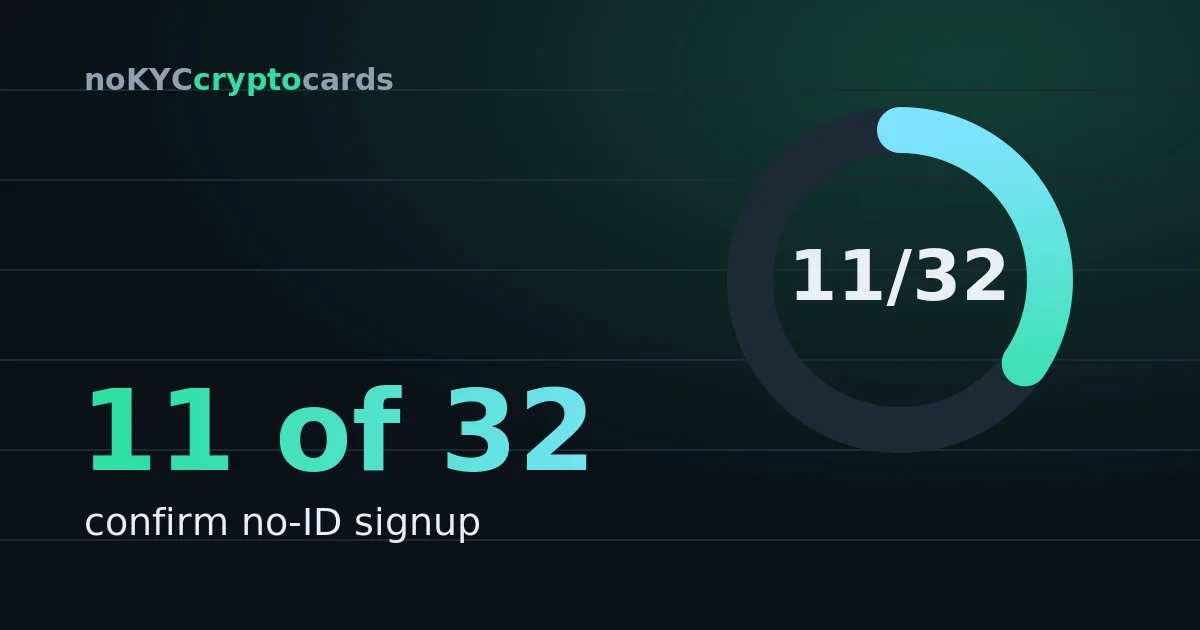
A card listed as “no KYC” is only as private as its own terms. We took every one of the 32 cards on CryptoCards.so’s no-KYC page and checked each provider’s website on 29 October 2026. Only 11 say plainly that standard signup needs no identity documents.
- 11 of 32: provider says no ID documents for standard use.
- 6: no-ID use limited to low tiers or basic features.
- 3: provider’s own terms require KYC.
- 6: provider pages checked do not state a KYC rule.
- 4 sites blocked or down; 2 cards appear discontinued.
Three listed cards require KYC on their own sites
BingCard says all clients are expected to complete comprehensive KYC (own terms). Pay2.House’s AML policy requires complete identity verification before financial transactions (own terms). XHYPE / Xkard says its cards require private KYC through Verinex (own terms).
Six allow no-ID use only up to a point
LinkPay says basic operations work without verification but higher limits need KYC (own terms). RivoCard ties spending limits to the verification level (own terms). woocard says simplified due diligence may apply only to eligible low-limit tiers (own terms). Gpayvcc asks for name and phone and may require more (own terms). UnCard says KYC depends on the plan (own terms), and Leading Cards offers limited access with simplified verification to low-risk users (own terms).
Even the no-ID cards keep the right to ask
The clearest statement came from Nocturne: “there is no KYC step” (own terms). Others add caveats. WaldenPay says an email-only signup does not make the account anonymous and that additional checks may apply (own terms). ZeroID’s terms reserve the right to run identity verification where necessary (own terms). Azura screens deposits under AML and sanctions rules (own terms).
Six cards do not say, and six could not be checked
For 6 cards, including Agora Cards and Laso Finance, the pages we read state no KYC rule at all. Four sites were blocked or down when we tried, and two listed cards look gone: Spendly’s domain is for sale, and StealthCards is marked discontinued on the list itself.
What this means
A third-party “no KYC” label is a starting point, not a guarantee. Check the provider’s own FAQ and terms, expect low limits without ID, and assume the issuer can ask for documents later. Our card directory links each claim to its source on a page per card, and how we rank explains how we order our Top 3. Related: no-KYC vs KYC crypto cards, fees compared and published limits.